Match mode
A game mode: back-to-back mini-games as a two-team match
Type: Game mode · Players: two teams (or free-for-all) · Status: Beta
Match mode is in beta — details may change.
Tournament isn’t a game of its own — it’s a mode that strings the rest of the library together into a Mario-Party-style match. The room splits into two teams, the launcher draws a random mini-game each round, and placement in each game scores points for your side. After a set number of games, the team with the most points wins.
How a match runs
Viewers join a team by typing !a or !b (or the team’s custom name).
In a cross-stream match, each streamer’s chat is a team automatically.
Each round the launcher spins up a random mini-game from the eligible pool and runs it for a minute or two. You play it exactly as you normally would.
When the mini-game ends, everyone’s finish is scored into team points, and the match rolls on to the next draw.
After the last game, the team with the highest cumulative score takes the match.
The round loop
Each round is the same shape: teams in place, a random game drawn, placement turned into points, and the totals carried forward — repeated for the length of the match.
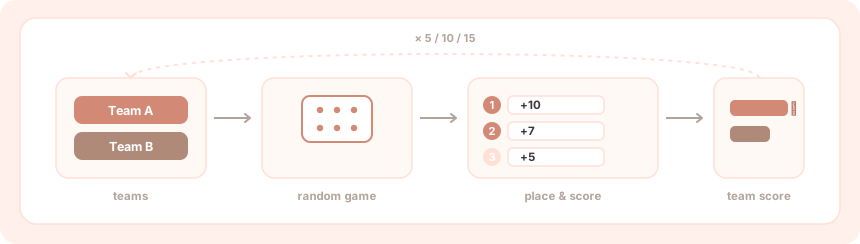
- Random draw, no repeats. Each round pulls a fresh game from the eligible pool; the wheel is paced so two slow games never run back to back.
- Short rounds. Every mini-game runs with a trimmed round count so it lands in the one-to-two-minute range and the match keeps rhythm.
- Placement scores. How you finish each mini-game — not the raw score — turns into team points (see Scoring).
Scoring
At the end of each mini-game, players are ranked by how they did, and the top finishers earn points for their team:
| Finish | Points |
|---|---|
| 1st | 10 |
| 2nd | 7 |
| 3rd | 5 |
| Anyone else who scored | 2 |
| Didn’t score | 0 |
- Points go to your team. Each teammate’s points add to the team total for that round.
- Ties share a rank. Players tied on a mini-game share the same placement, so a two-way tie for first both earn the first-place points.
- The match total decides it. Team points accumulate across every game; the higher total after the last round wins. If the two teams end level, both rosters are shipped as co-winners.
Match formats
A local match on one stream. Your chat splits into two teams with !a / !b, and you can rename the sides so viewers rally behind !sharks vs !jets. Prefer a solo scramble? Run it free-for-all — no teams, and the
individual with the most points wins.
A cross-stream match. One streamer hosts and another joins with an invite; each streamer’s chat becomes a team, so it’s your room versus theirs. The match waits for the challenger to connect before the first game starts.
Configuration
| Option | Values | Default |
|---|---|---|
| Length | 5 / 10 / 15 games | 5 |
| Rounds per game | Auto, or 1 / 2 / 3 / 5 | Auto |
| Team names | custom labels (local parties) | Team A / Team B |
| Game pool | pick which games can be drawn | All eligible |
| Free-for-all | teams off, individual scoring | Off |
Length. How many mini-games make up the match.
Rounds per game. Auto uses a tuned round count per game to keep each one short; you can also pin every game to a fixed number of rounds.
Team names. Local parties can name the two sides (cross-stream parties always use Team A / Team B, since the teams are the two chats).
Game pool. Scope the draw to a handful of favourites, or leave it on the full eligible set.
The game pool
The wheel draws from the round-based games whose finish order reads as a fair placement — most of the Trivia, Word, and Puzzle library. Games built around fixed roles (a hot seat or a 1v1 seat) or co-op gifting sit out, because there’s no head-to-head placement to score. The launcher’s setup picker shows exactly which games are in the pool.