Most Likely To
The room nominates each other, crowns somebody, and hears them out
Category: Party · Players: free-for-all · Status: Beta
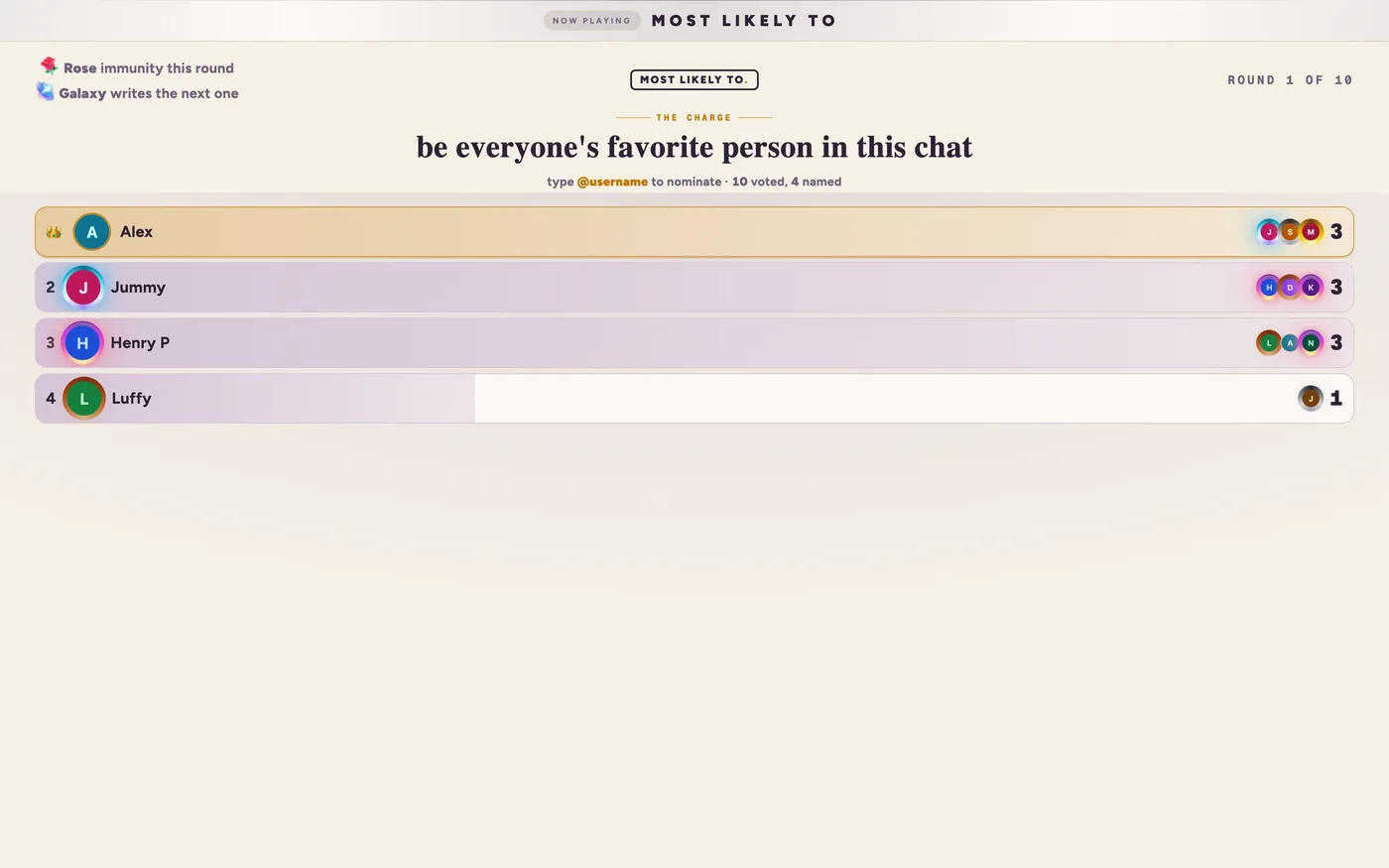
Most Likely To is in beta — details may change.
A prompt appears on screen — “most likely to start a cult accidentally” — and
chat nominates by typing @name. The tally builds live as a race, the biggest
bar takes the crown, and the crowned chatter gets the microphone to defend
themselves while everyone else types guilty or innocent and the bar moves
underneath them. There is no score and nobody wins: the verdict is the game, and
the closest thing to a prize is a role on the end card.
It is Never Have I Ever’s sibling and plays nothing like it. That one asks chat about themselves and the split is the game; this one asks the room about one person, and the crown is the game. Anyone can be nominated — yourself, your friends, the streamer.
Gameplay
Type @name for whoever the prompt describes. No !join needed — nominating
enters you — and you can change your mind as often as you like, which moves your
vote rather than adding a second one.
The @ is required. Without it, every nickname said in passing would land as a
vote for somebody, and a stray vote here isn’t a miscount — it’s a stranger’s
face on screen under an accusation.
You can only nominate chatters the room has already seen. An @ at someone who
has never typed misses rather than putting a faceless name on the board.
The host closes nominations — or the optional timer does. The biggest tally is crowned, the room gets its one line of editorial (“landslide — 9 of 11”), and a tie is settled by coin flip rather than by whoever was named first.
A round where nobody nominated anybody crowns nobody, and moves on.
The crowned chatter goes center stage and their chat messages become their
defence, until they type pass or the 43-second clock runs out. While they
talk, everyone else votes: guilty or innocent, upsert-style, with the bar
tipping live under the plea. At the end the verdict lands — GUILTY, NOT
GUILTY, or HUNG JURY when the room can’t agree.
pass always works, instantly, no questions. The host can also take the mic
back at any time with Call the verdict, which stays on the crown card
instead of moving on.
Crowns stack up along the bottom of the stage as the session runs. By round nine the room is nominating against everything it has already decided — which is the point, and the thing a static prompt deck can’t buy on its own.
Nobody gets accused of anything real
The crown lands on a named, real person, so the deck is built out of three things and nothing else: harmless vice (“start a group project the night before it’s due”), absurd ambition (“start a cult accidentally”), and outright compliments (“text you first when you’ve gone quiet”).
Nothing anybody would have to deny. The entire cheating/lying/betrayal family that Never Have I Ever handles comfortably in the first person is absent here, because in the first person it’s a confession and in the third person it’s an accusation with somebody’s handle on it.
Minor Offences is the other end of the same idea. It is comic vice — the office fridge, the parking space, the group chat left on read — and it exists because being accused of those is funny precisely because nobody has to deny them. It came out of reading a published “Bad People” card deck against this deck’s rules and keeping the fifth of it that survived: that game is built on accusations this one can’t make, and it works because its players are friends who opted into being roasted rather than strangers in a public room.
Actually Wholesome is a full theme for the same reason. A deck that only accuses is exhausting by round six, and a room that learns the crown is always an insult stops nominating its friends. Mixing in rounds where being crowned is the nicest thing that happened to you all stream keeps the nomination itself ambiguous — which is the whole tension.
Beyond that, prompts use the same house code as its sibling for anything a live stage shouldn’t say outright, always in quotes and styled so the wink is visible: “spicy water”, “getting busy”, “overserved”.
Configuration
| Option | Values | Default |
|---|---|---|
| Theme | Mixed, Chaos Goblin, Terminally Online, Group Chat Energy, Love & Situationships, Main Character, Adulting, End of the World, Famous For It, Night Out, Actually Wholesome, Secret Talent, At The Table, Scaredy Cat, Inner Child, Minor Offences | Mixed |
| Prompts | 3–25 per session | 10 |
| Nomination timer | 10–300 seconds, blank = host-paced | Off |
| After the crown | defence + verdict / defence only / straight to the next one | Defence + verdict |
| Immunity gift | one gift that takes the sender off the board | Rose |
| Write-a-prompt gift | one gift that buys the next prompt | Galaxy |
| Who writes them | The deck · Chat writes every one · Alternate | The deck |
Who writes them. By default every round comes from the deck. Switch this to Chat writes every one and the game picks a random chatter before each round and hands them 35 seconds to type the prompt — it goes up with their name under it, exactly like a bought one. Alternate deck and chat runs deck, chat, deck, chat.
Four things keep it from stalling the show, which is the whole reason it is shippable:
- Only people who have actually played are eligible. Handing the pen to a lurker buys 35 seconds of dead air and nothing else.
- The pen rotates — it goes to somebody who hasn’t had it yet before it repeats, so one person can’t end up writing six rounds.
- A message that doesn’t fit leaves the window open, so somebody put on the spot gets more than one go.
- If they don’t deliver, the deck’s own card plays, on time. The round is never waiting on one person who went to make a cup of tea.
Round one is always the deck’s, even in chat mode — nobody has played yet, so nobody is eligible, and a stranger shouldn’t be asked to write a prompt before the room has seen what one looks like.
Mixed spreads, it doesn’t sample. A mixed session deals one prompt from each theme before it deals a second from any, so a ten-round session is ten different registers and never parks in one. A flat random draw out of a deck this shape lands three or four rounds in the same theme often enough to be the common case, and a session that opens with four Night Out prompts reads as a themed session you didn’t ask for.
Prompts your room has seen are held back. The draw remembers what it dealt your room and prefers cards it hasn’t, resetting only once the deck is spent — so back-to-back sessions don’t repeat, and a room that plays weekly works through 500 prompts before it sees one twice.
Immunity gift. Sending it takes you off the board for the round: nominations naming you stop counting, and any already cast are wiped. It works retroactively on purpose — the reason to buy it is that your name is already up there. Bought outside an open round it banks to the next one rather than being refused. Your name shows on stage as untouchable while it holds, because an exit nobody can see isn’t worth paying for.
Write-a-prompt gift. On by default, set to Galaxy — writing the board should cost something real, or the deck goes to whoever is fastest rather than whoever is committed. A viewer sends it, then types a prompt in chat, and it goes up as a real round with their name under it — “written by @ann”. Up to eight per session.
Two things worth knowing, since it’s on unless you clear it:
- A bought prompt is added to your deck, not swapped in for one of yours. A ten-prompt session with three bought prompts runs thirteen rounds.
- A bought prompt may not name anybody. A submission containing an
@handleis refused outright — the buyer picks the words, the room picks the target. Beyond that the engine strips a typed “most likely to” prefix (the stage renders that itself), links, and double quotes. The quotes matter most: the stage styles any quoted span as house code, so leaving them in would let a viewer fake the deck’s own voice. If a message survives none of that, the writing window stays open so the gifter still gets their go.
Layout
- Marquee — game title and how-to hint.
- Prompt band — the prompt with quoted code words styled, the buyable mechanics, the round counter, and any immunity currently held.
- The board — one row per nominee: their bar, their vote count, and the faces of everyone who put them there. The rows reorder as the tally moves, because a name overtaking another has to be seen happening.
- The dock — the full-stage defence card: the crowned chatter with the clock wrapped around them, their messages as bubbles, and the guilty / innocent bar.
- Rap sheet — the crowns so far this session.
- Filmstrip — the night so far, one verdict per round.
The game moves through Lobby → Nominating → Crowned → Defence → Finished.
Roles, not ranks
At the end the room gets its portrait instead of a scoreboard. Each role goes to the top scorer not already holding one, so a dominant chatter takes one card rather than sweeping the board:
| Role | Earned by |
|---|---|
| 👑 Most Wanted | crowned the most times |
| ⚖️ The Prosecutor | cast the most nominations |
| 🗝️ Kingmaker | backed the eventual crown most often |
| 🕊️ Smooth Talker | talked the jury round most often |
| 🙋 Attention Seeker | nominated themselves the most |
| 🔨 The Hanging Judge | voted guilty the most |
| 🤝 Character Witness | voted innocent the most |
| 🧊 The Untouchable | named all night, never once crowned |
Achievements
| Badge | Earned by |
|---|---|
| Crowned | your first crown of a session |
| Landslide | taking the crown with three-quarters of the room |
| Not Guilty | defending yourself and having the room vote innocent |
| Kingmaker | nominating the eventual crown five times in one session |
| Perfect Attendance | nominating in every round of a session |
There is no 50-wins avatar motif for this game — it has no wins to count, which is the point.