Chatvas
One viewer draws it on their phone. Chat races to name it.
Category: Party · Players: 2+ · Status: Beta
Chatvas is in beta — details may change.
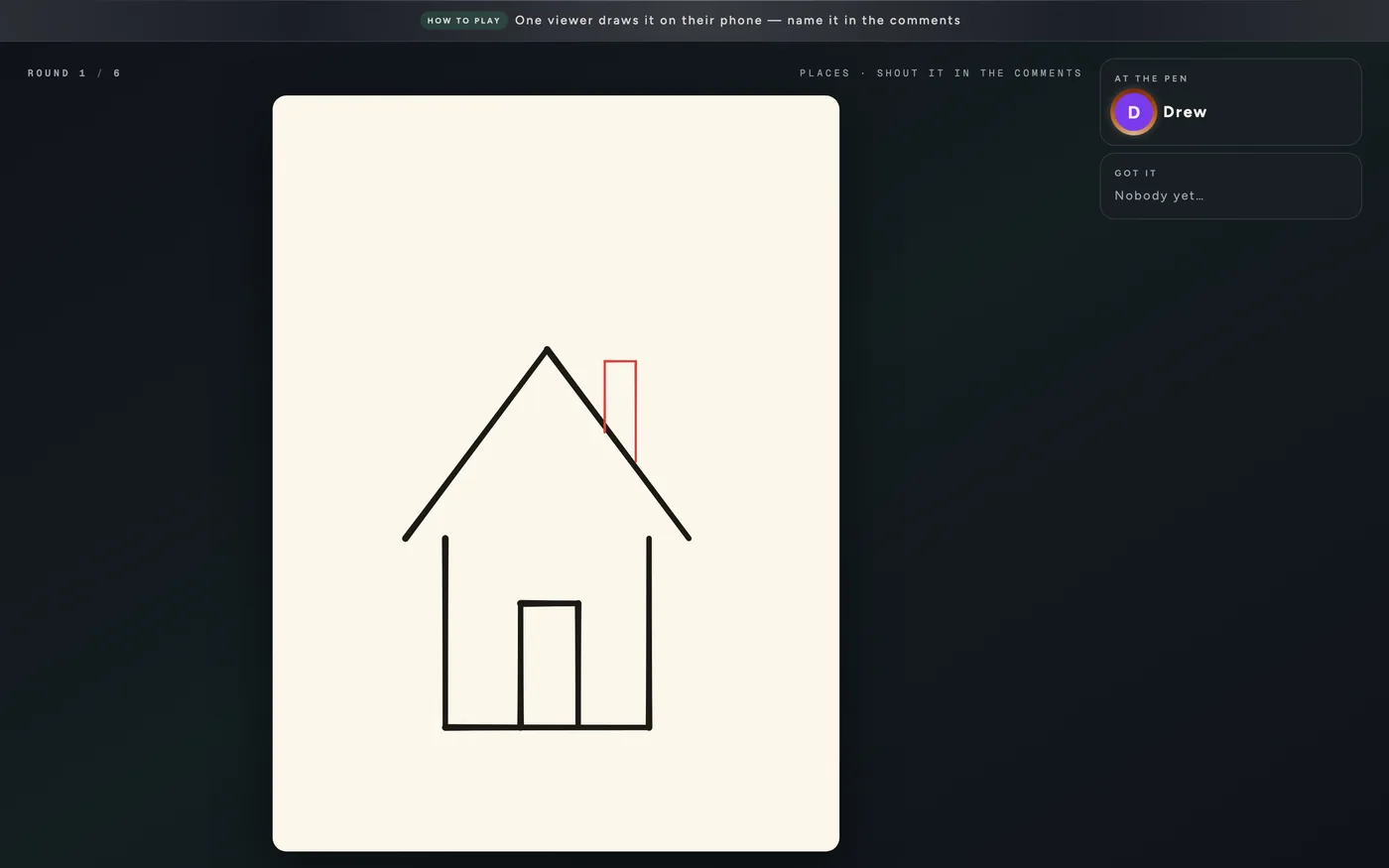
Draw-and-guess with the pen handed to chat. Everyone who joins the game is in the artist pool; each round you pick one of them, they open your companion page and get a word only they can see. They draw it with a finger, the strokes land on your stage as they happen, and everyone else races to name it in the comments.
The word is never in anything the broadcast renders — not masked, absent. It exists in exactly one place: the reply to the tap that took the pen. That’s what makes the game possible on a public stream, where the alternative is showing the answer to the room you’re asking to guess it.
Round
There’s no volunteering step. Joining the lobby (!join) puts a viewer in the
artist pool, and so does simply guessing mid-game — the room plays from the
stream it’s already watching, and nobody opens anything to enter.
Hit Pick an artist in your controls whenever you’re ready — nothing here runs on a timer, so nobody plays rushed. The game rolls inside the pool: picking favours whoever has drawn fewest times this session, so the pen goes right round your regulars before anyone gets a second turn, and a newcomer who joins at round six goes straight to the front. Your click decides when, never who.
The stage announces the pick by name, with the address — livehub.gg/w/@streamer, your handle. They open it, tap once, and the word is
theirs. No login, no app, and no rush: the pen waits until they’re in. If they
never show, re-roll — they sit out that word and someone else is picked.
The claim is on trust: the page can’t prove who’s holding the phone. If someone else grabs a pen that isn’t theirs, skip the word from your controls and move on.
Eight colours, four nib sizes, an eraser and an undo. Nothing else — the constraint is the point. The room’s latest comments float over the bottom of their canvas, TikTok-style, so the artist sees the guesses land and can steer without leaving the pad.
Anyone types the word in the comments. No command and no prefix — any
message during the round is a guess, because asking a racing room to type !guess is asking them to lose. Case and punctuation are ignored.
You call the round from your controls — there’s no clock unless you set one in setup, and the artist can give up. The word goes up on the canvas next to what it actually looked like, and the next pick opens.
Scoring
The first correct guess pays most and later ones still count, so a round someone solves in ten seconds is still worth playing out.
The artist is paid once for the room getting there — whoever gets it, and however many people do. That’s deliberate: being paid for the room rather than per guess means there’s no reward for giving the word away.
And because the artist is picked from chat, the game knows exactly who they are: their own guesses don’t count, under the handle the whole room saw get picked. What that can’t catch is a second account — so the game also refuses any guess that lands before the drawing has been on screen long enough for anyone to have seen it. Your viewers are several seconds behind the stream; a real guess can’t be that fast. The rest is the room’s to notice — a drawing “solved” the instant it appears is obvious to everybody watching.
Notes
The delay is real. Your viewers watch through a broadcast delay of roughly five to twelve seconds, so the artist sees a reaction long after the line that caused it. That’s why there’s no drawing clock unless you set one — and why a short one feels broken rather than tense.
Open your stage before the round, not during it. Strokes are sent live and aren’t replayed, so a stage that connects mid-round has missed what was drawn before it arrived. It says so on the canvas rather than showing an empty page.
Setup
Pick a category (or leave it mixed), a difficulty — easy words are one shape each, tricky ones need a whole scene — how many rounds, and optionally a drawing clock. Words draw through deck memory, so a room that plays weekly works through the deck before it repeats. That matters more here than in a guessing game: a repeat word means a repeat drawing, and regulars remember drawings long after they’d have forgotten a trivia answer.